
 By
By
🔴 Order Jan’s new book "Killed to Order": http://killedtoorder.com/
🏆Sponsor: FreedomProject Academy enrollment open now!
10% discount on tuition w/code: EPOCH10
Click here: https://ept.ms/ATL—FPE
🔵 Support independent journalism and subscribe to The Epoch Times now for just $1 per week: https://theepochtim.es/ATLUSA
Canada Edition: https://theepochtim.es/ATLCA
🔵 Sign up for the American Thought Leaders ALERTS newsletter to stay up-to-date on new episodes, releases, and special events 👉 https://ept.ms/ATLnewsletter
A recent landmark Jamestown Foundation report maps Chinese United Front operations, the Chinese Communist Party’s (CCP’s) effort to co-opt and weaponize civil society against the CCP’s enemies.
The report, titled “Harnessing the People” and authored by researcher Cheryl Yu, identifies more than 2,000 such organizations operating in the United States, Canada, the United Kingdom, and Germany. More than 1,000 are operating in the United States.
They span a wide range, including student, business, professional, cultural, and “friendship” groups as well as media outlets.
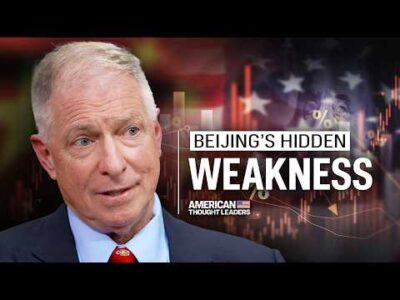
In this episode, I sit down with Peter Mattis, president of The Jamestown Foundation. Few understand this complex web of Chinese influence and espionage operations as well as he does.
His storied career includes roles such as senior fellow with the U.S. House Select Committee on the CCP, staff director of the Congressional-Executive Commission on China (CECC), and counterintelligence analyst for the Central Intelligence Agency.
The United Front has two distinct areas of operation: inside China and outside China. Basically, every Party committee in China has a United Front department, Mattis said. But, he said, “the big part of the work that really matters to us happens outside. … This is a system that involves hundreds of thousands of people.”
“Mao Zedong described United Front work as a tool to storm and shatter the enemy’s position,” Mattis said.
One key task of United Front operations overseas is to find people, in particular scientists and engineers, who “are susceptible to recruitment,” Mattis said.
Many seemingly innocuous civic groups in Western countries—for example, the China Overseas Friendship Association—are used to observe, identify, and then target people who could be useful for technology transfer or even intelligence purposes.
How are targeted people approached? Typically, it’s through one of the estimated 600 talent programs that Beijing has created for this objective, Mattis said.
Programs include the Young Thousand Talents Program, which targets early-career STEM researchers, and the Hundred Talents Program, which targets scientists under 45.
Out of the four Western countries explored in the report, Canada has by far the largest number of United Front organizations per capita, five times as many as the United States.
Why, I asked Mattis, is Canada so important to China?
“It is a soft underbelly to the United States [and] to the rest of NATO,” he replied.
In Canada, he told me, there has been far less pushback against United Front organizations than in the United States.
“These groups have never really had to hide themselves. They never really had to be careful, and therefore, they could just sort of move and operate,” he said.
There are even high-level Canadian officials, senators or MPs, “that you see embedded essentially in a network of these United Front organizations,” Mattis said.
In this episode, Mattis breaks down the playbook of Chinese United Front operations. Here’s how they co-opt overseas Chinese communities, monitor and pressure dissidents, and manipulate electoral outcomes.
💛 Support us 👉https://donorbox.org/american-thought-leaders
————————————————-
© All Rights Reserved.















Comments